World Watch List 2010
Murder, kidnap, imprisonment, harassment, discrimination, prevented from meeting for worship… persecution is alive and all too well in 2010. It affects millions of Christian believers. It’s growing, too. But then so is the church.
Christians have no shortage of persecutors in 2010. Yet, against all odds, they are also part of a vital and growing global church.
World Watch List 2010 (Video clip 4 mins)
Developments in 2009
Last year, in North Korea a 150-day 'battle' – a government initiative intended to boost the economy – saw hundreds of Christians arrested in house searches, and many sent to join the 50–70,000 already in labour camps.
In Yemen three expatriate Christian health workers were killed and mutilated. In Iran at least 85 Christians were arrested and a number of house churches closed. In Mauritania the government rounded up and tortured 35 Christians who came from a Muslim background.
Two thousand years ago the Roman Empire tried to persecute the church out of existence. The Roman Empire collapsed; the church grew. Two thousand years later, the growth of the church still prompts persecution... and the church keeps growing.
In North Korea one observer reported, "Christians are the target of fierce government action, and once caught, are not regarded as human – this year we have evidence that they are used as guinea pigs to test chemical and biological weapons." Yet the number of Christians in North Korea has grown in the past ten years.
In Iran more and more people who have grown up as Muslims are becoming Christians. As disillusionment with the theocratic Muslim government grows, so does the longing for spiritual truth. Miracles, dreams, the internet, satellite TV – all are being used by God to draw people to Himself.
Areas of concern
The pattern of persecution is not uncommon across the Muslim world. Islamic extremism, whether sponsored by the state or acting in spite of the state, is the source of persecution in over 35 of the countries where faith costs the most.
This is especially true for those who, having been raised in a Muslim society, choose to follow Christ. Where religious, cultural and national identity are so closely intertwined, becoming a Christian has very real consequences politically and socially. This is why, in so many places, evangelism and conversion are seen as such subversive activities that they provoke violent and legal retaliation.
This reaction to the sharing of the gospel is not restricted to Islamic societies. It is the root of the Hindu extremist harassment of Christians in India; in other countries it may come from Buddhists or even from other Christians.
Christians are also seen as a threat by totalitarian governments. Former Communist states particularly find it hard to allow people to gather together in small groups outside the control of the government.
In this situation persecution is often focused on control of where people meet. In Vietnam the nominally Communist government is hampering and restricting the growing church: there have been large-scale confrontations between believers and government over confiscated church property, with scores of believers beaten and arrested during the protests.
Three Central Asian states – Azerbaijan, Tajikistan and Kyrgyzstan – passed restrictive religious laws in 2009, making the situation for the minority Christian church more difficult. In Kyrgyzstan, for example, registration is limited to religious meetings with a minimum of 200 people, effectively outlawing meetings in house churches.
So while Christians rejoice in the remarkable improvements in religious liberty in Latin America over the past ten years, the new decade begins with Christians facing increasing violence in many Muslim countries. And in North Korea and Laos it is as hard as it has ever been in living memory to preserve a Christian witness.
How the World Watch List is constructed
The unique list, begun by the Open Doors Research Department in 1991, seeks to understand the unique persecution fingerprint of each country. This is to ensure effective intervention since Open Doors ministers to the persecuted church in over fifty countries worldwide. The data is derived from a questionnaire containing fifty-three questions sent to Open Doors co-workers, key church leaders, and recognized experts in seventy countries. The questionnaire examines every aspect of persecution, including the degree of legal restriction, state attitudes, how free the church is to organize itself, as well as noting incidents of persecution such as church burnings, anti-Christian riots, and even martyrdoms. Open Doors is uniquely situated to provide this research as it is the world's largest missions agency working on behalf of the persecuted, and of the top fifty countries Open Doors preserves an active program in forty six of them.
Top 50 countries for persecution of Christians

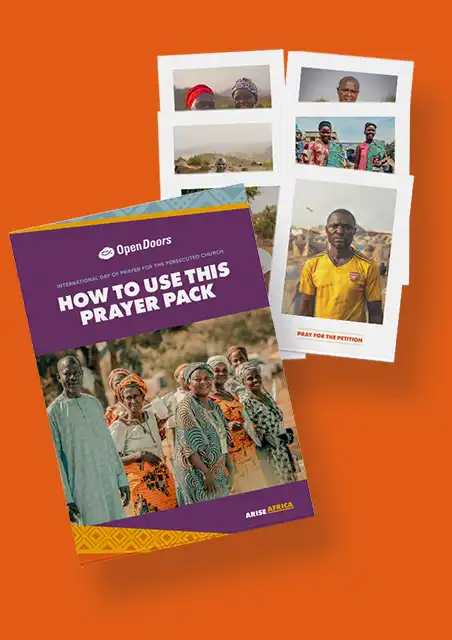
Handbook of Prayer for the Persecuted Church
This handbook of prayer is based on our annual World Watch List of the top 50 persecuting countries. We have also created a special World Watch poster to accompany it. These resources help to inform people about the extent and severity of persecution in the world and inspire them to pray for their suffering family in Christ.
Order your Handbook of Prayer »
|